

How Bridge Data Centres flipped the script on water in Johor
A look inside Southeast Asia's first data centre-operated water reclamation plant.

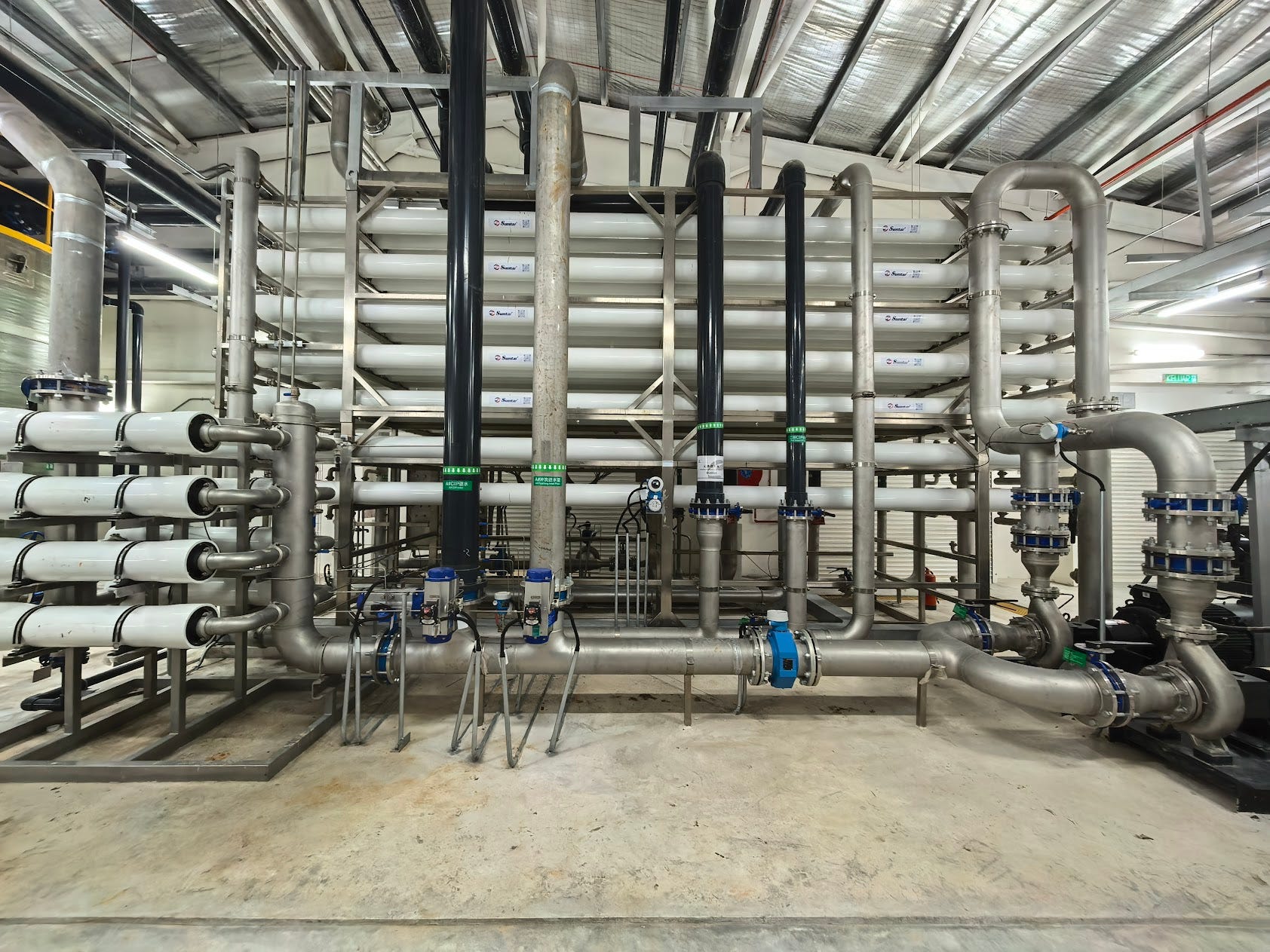
Johor had just one 10MW data centre in 2021. Today, the state at Malaysia’s southern edge has operational data centres in the hundreds of megawatts, with gigawatts more under construction. How is a state of four million people coping with this influx, particularly when it comes to water? Last month, I visited a facility that offers one answer.
For today, let’s take a look at the water situation in Johor, the insides of an operational water reclamation plant, and why one data centre operator is doing things differently.
Thirsty data centres
Data centres require a massive amount of water for two reasons: for use in evaporative cooling and to replenish water as it accumulates minerals and other contaminants over time. You can read a short explanation I wrote on my Tech Stories blog here. In practically every market, the challenge around water can be attributed to the sharp growth of data centres and the corresponding rise in demand.
No wonder Johor will stop approving applications for Tier 1 and Tier 2 data centres*, as reported by The Straits Times last month. Another report by the South China Morning Post noted how investors in Johor have been asked to postpone water-cooled expansion projects for at least 18 months.
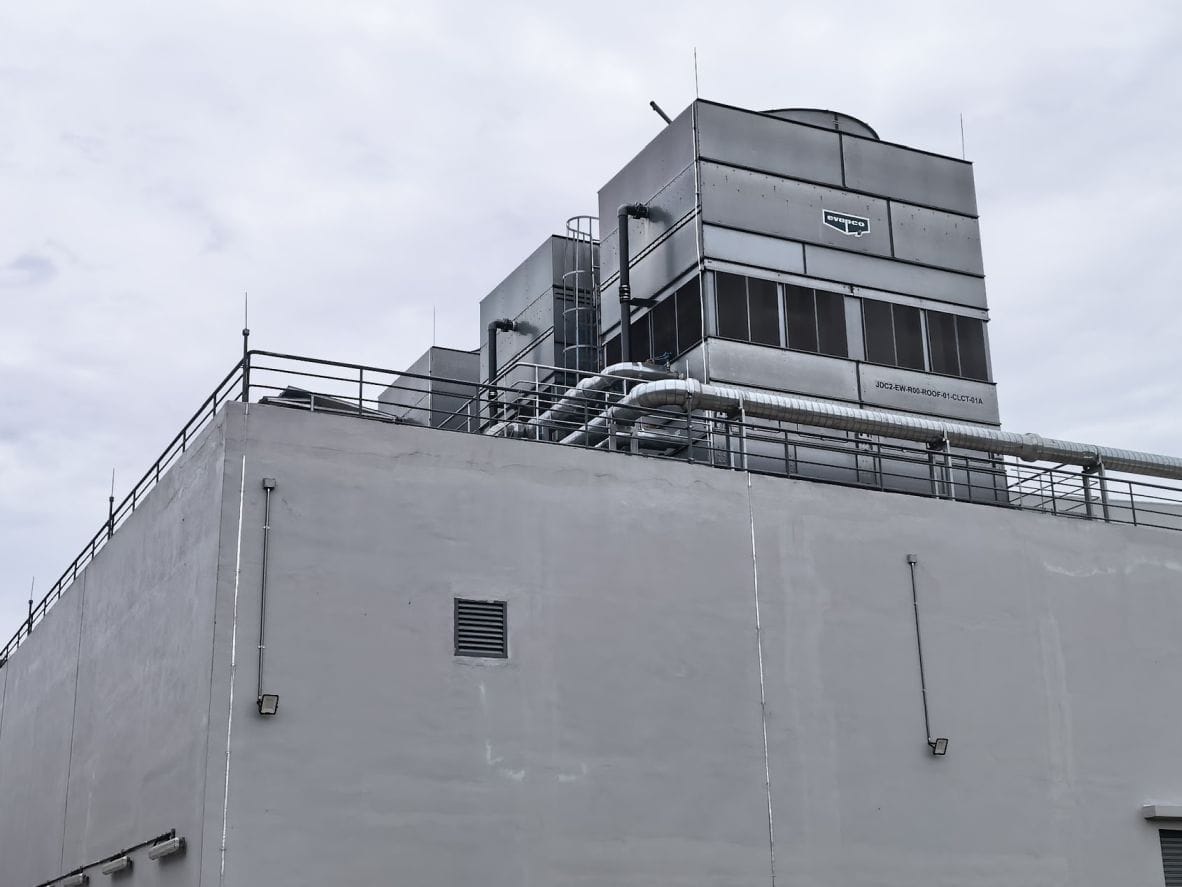
To be clear, multiple schemes are underway to increase the supply of treated water. As I wrote last month, an infrastructure programme has been initiated to divert surplus water southwards from central and eastern regions, which have abundant water. Johor is also urgently building two water treatment plants: the Semanggar Plant with 50 million litres per day (MLD), and Layang 2 Phase 2 Plant with 160 MLD.
What the reports do confirm, though, is how the breakneck pace of data centre growth is straining existing resources. This is hardly unique to Johor. But for investors and data centre operators, any delays in accessing water could potentially disrupt carefully laid plans.
*This appears to be an internal classification according to economic contributions.
Inside the water reclamation plant
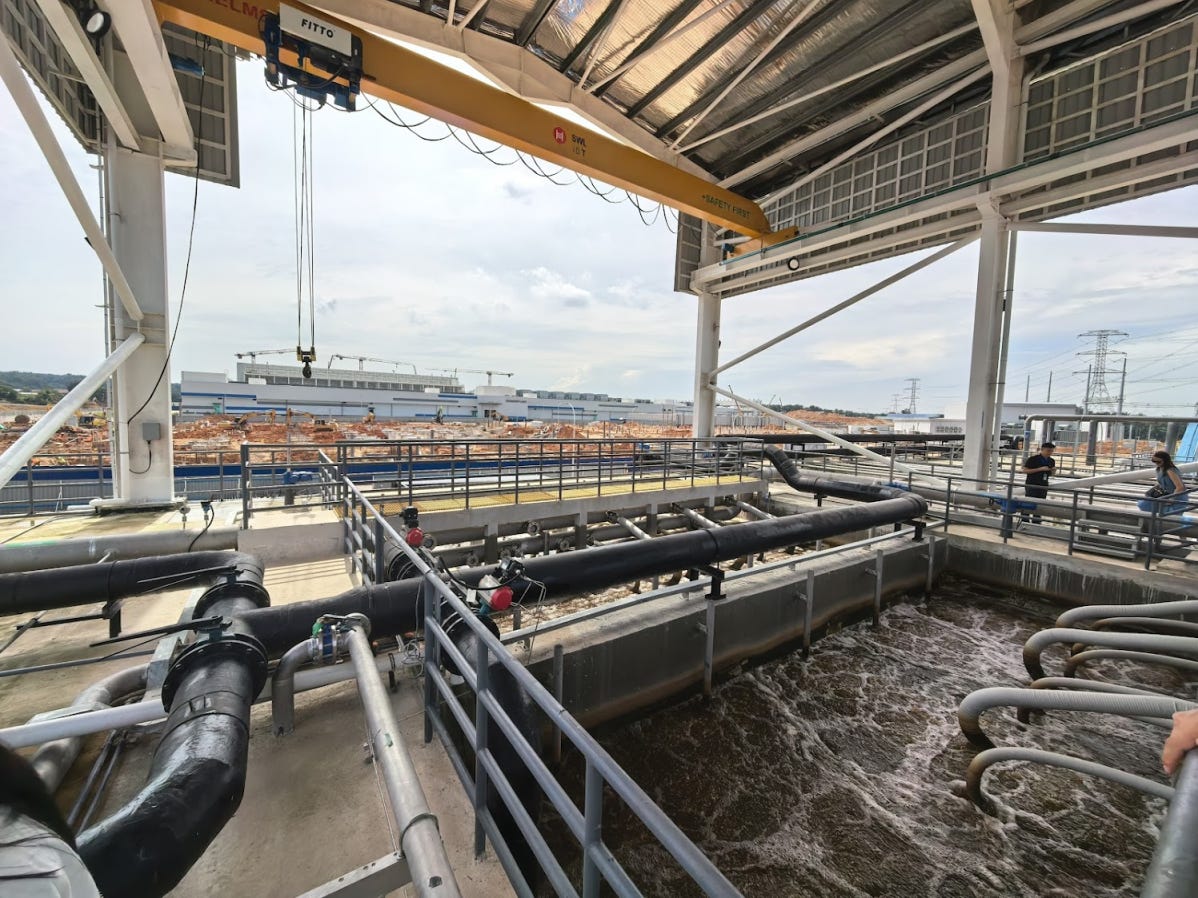
When Suntar offered to arrange a visit to the Bridge Data Centres Water Reclamation Plant, I jumped at the opportunity. The state-of-the-art facility is built within the compound of Bridge Data Centres’ 200MW MY07 data centre campus. It is currently the only operational water reclamation plant run by a data centre operator in Southeast Asia and underscores the evolving role of data centres.
What does it do? Well, the facility reclaims non-potable treated effluent from sewage treatment plants (STPs). By further cleaning it up, the effluent is reclaimed into high-grade water suitable for use by data centres. This means MY07 can potentially be completely “water neutral” by reusing effluent water that would have been discarded anyway.
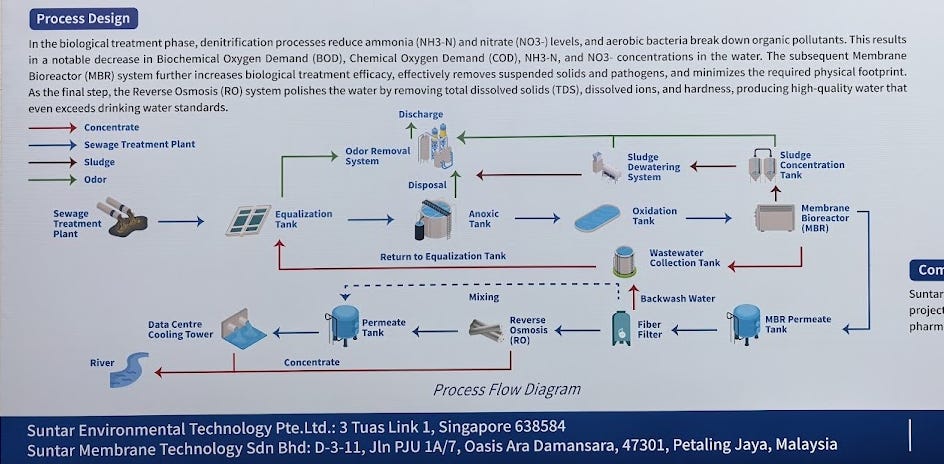
In this case, effluent comes from nearby STPs operated by Johor Special Water Sdn Bhd (JSW). Here are the multiple processes that the water goes through before it is ready for use in the data centre.


Description of the above photos from left to right, top to bottom:
Incoming treated wastewater from sewage treatment plants.
Metal screens designed to trap and remove larger sediments.
Oxidation tank (top); anoxic tank under trapdoor (bottom). They use bacteria to break down organic matter and removes nitrogen from water, respectively.
Membrane Bioreactor (MBR) uses ultra-fine membrane filtration to remove suspended solids, bacteria, and even some pathogens.
Fibre filter to remove fine impurities that remain.
Reverse osmosis (RO) uses high pressure to force water through an extremely fine membrane to remove dissolved and microscopic contaminants.
Bridge Data Centres’ water reclamation plant uses up to three passes of RO.
Resulting high-grade water.
Temporary storage tank for the water.
I also learned that there are processes to clean both MBR and RO membranes to extend their lifespans, which I understand to be measured in years. This is quite different from my previous flawed understanding that they must be discarded regularly.
The below chart below, mounted on the wall of the operations room, sums up the multi-step process.
Here are a couple of videos of processes that I could observe. The top video shows the flow of treated wastewater into the oxidation tank. The bottom video shows the membrane bioreactor in action.
More than just water savings
The water treatment process was far more complicated than I initially thought. But through my conversation and subsequent research, it was also clear that the technology is mature and widely deployed in various industries. In fact, the head of the water reclamation plant has extensive experience working in the semiconductor industry - where water quality standards are far higher.
A few things struck me: The beauty of this setup is how wastewater treatment plants offer more options to data centre operators, allowing them to improve power usage efficiency (PUE) and water usage efficiency (WUE). Moreover, the process is fully automated and can switch seamlessly to handle different water sources: wastewater effluent, rainwater, or surface water.
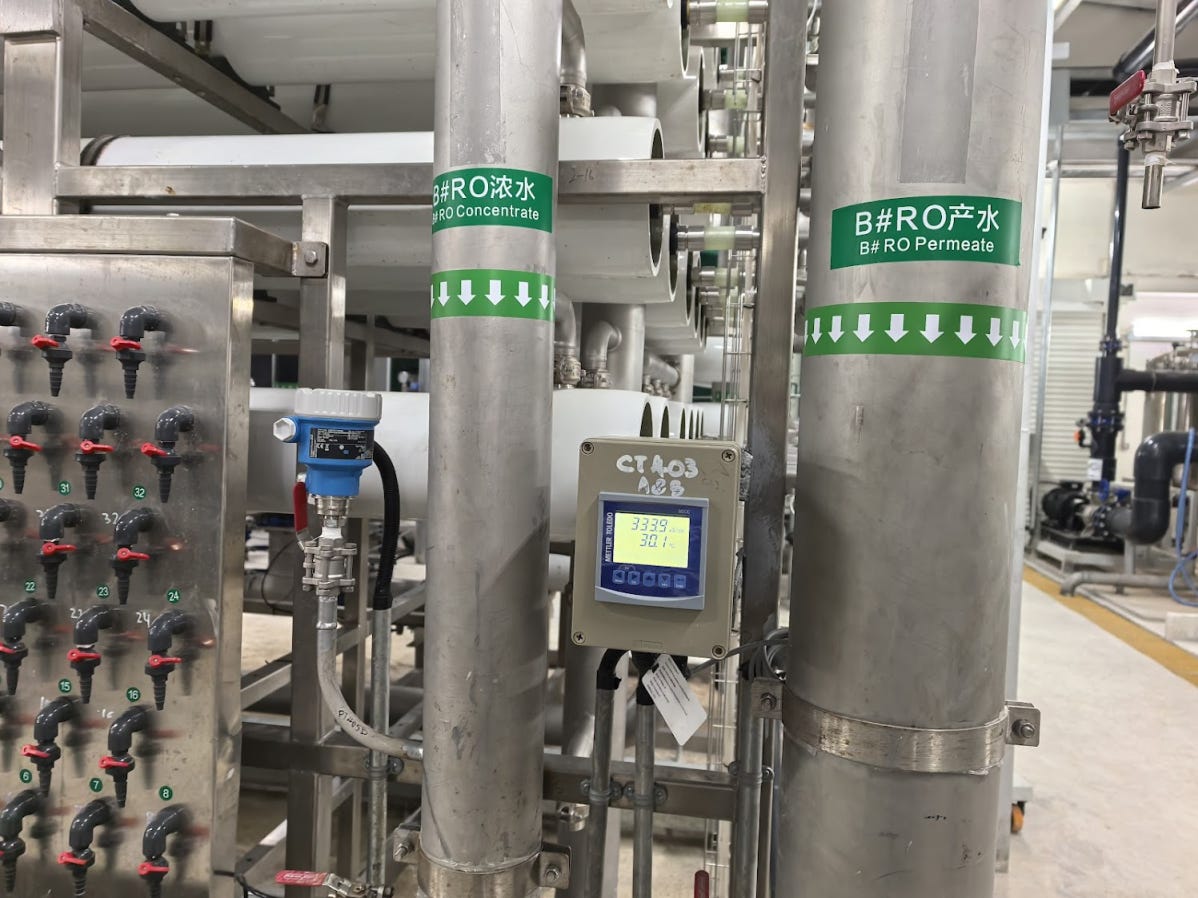
I was also told that reclaimed water generally has lower conductivity, which helps to increase the cycle of concentration (COC) for cooling towers, thereby increasing water efficiency. In fact, depending on how the plant is set up, it is possible to process blowdown water for reuse to improve COC further.
The Bridge Data Centres Water Reclamation Plant uses both MBR and RO, which gives it a water recovery rate of over 85%. This means less than 15% of incoming treated wastewater is discarded. In comparison, a simple UF system would have a much lower recovery rate of around 40-50%.
Other benefits of a water reclamation plant:
Repurpose effluent from sewage treatment plant that would otherwise be discharged into water bodies.
Avoid conflict with potable water demand and water stressed areas.
Achieve redundancy by eliminating dependence on a single water source.
Allow data centre operators to meet their sustainability and ESG goals.
As I understand it, the Bridge Data Centres water reclamation plant at MY07 uses automated systems for minimal supervision and lower operational overheads. The modular design also offers greater flexibility for forward-looking expansion.
The 20-year view
But why would Bridge Data Centres invest in a water reclamation plant, which would presumably incur hefty capital expenditure? When I posed this question, Eric Fan, CEO of Bridge Data Centres, explained that this is simply how Bridge Data Centres does business.
While others make “green pledges,” his firm simply walks the talk. But what struck me about Bridge Data Centres is how extraordinarily far ahead it thinks. Fan wrote in an emailed response:
“At Bridge Data Centres, we build for what is next. Designing for a 20-year lifecycle means every decision, from energy sourcing to water systems and building materials, is made with future-readiness in mind. We plan from day one for technology evolution, higher-density workloads, and stricter environmental standards; ensuring our infrastructure remains both high-performing and sustainable as the industry advances.”
The long lifecycle translates into a greater willingness to invest in technologies that increase sustainability. This includes working with technology partners and the public sector to make projects such as its water reclamation plant a reality.
“Our work with Suntar, JSW, and local regulators shows that when private and public sectors collaborate, we can balance data growth with environmental responsibility. We are building towards such a future.”
And Johor is just the beginning. According to Fan, Bridge Data Centres plans to scale its green energy adoption and water recycling practices across every market it is currently in: Malaysia, India, Thailand, and beyond.
What else is Bridge Data Centres exploring right now? Fan says the company is “actively exploring” clean energy in areas such as hydrogen-ready power and other renewable fuels. It is also deploying smarter cooling systems including immersion cooling, energy-storage-enabled power stacks, solar integration, and AI-managed energy systems.
I guess I’m going to have to see if I can visit one of its data centres.
What comes next
Of course, Bridge Data Centres isn’t the only data centre operator to turn to treated wastewater, but merely the first of several to go live with its water reclamation plant. Earlier this year, both AirTrunk and DayOne made similar announcements.
What is clear to me is how the role of data centre operators has evolved. As data centres grow in scale, operators must now consider a growing list of factors including sustainability. Beyond increasing the efficiency of mechanical and electrical systems, this means building capabilities around energy generation and water treatment. The data centre industry is growing up. And in Johor, that means learning to treat its own water.