

Singapore's audacious bet on sustainable data centres
It's finally out. Here's what I think the DC-CFA2 means for the data centre industry.


It’s been a week since IMDA and EDB announced Singapore’s DC-CFA2. In my defence, I was away with my family. Given what I already know, and the timelines involved (three months for submissions), I figured I’d keep holidaying and only read the release when I’m home and ready to write something meaningful.
Well, I finally looked at it and let’s just say it gave me goosebumps. Not in a bad way. It dawned on me that once again Singapore is moving to do something that nobody has done before, or where many would have given up. And if the plan succeeds, it’ll completely change what it means to build a sustainable data centre.
What is the DC-CFA?
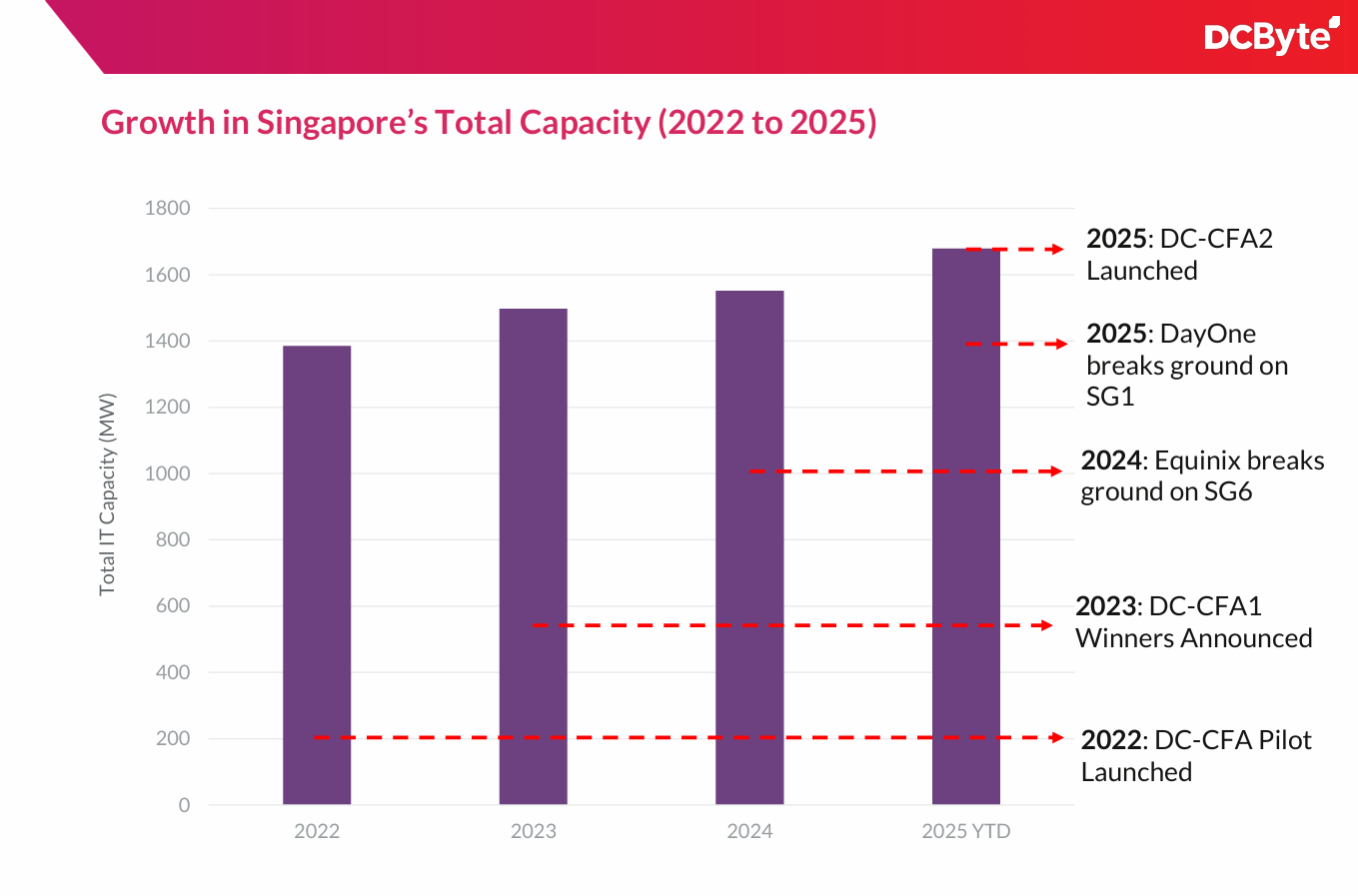
But first, what is the DC-CFA? It stands for Data Centre-Call for Application, and it has emerged as the Singapore government’s primary mechanism to allocate new data centre capacity. There is one other pathway that I know of, but the DC-CFA shall be our focus today. The idea behind the DC-CFA is controlled data centre growth, which really began as far back as 2019 with the imposition of an “implicit” moratorium for almost three years. That’s an eternity even in the pre-AI data centre era.
The moratorium was eventually lifted and immediately followed by the pilot Data Centre-Call for Application, which offered data centre capacity to operators who can meet a bunch of criteria designed to benefit Singapore and advanced sustainability. The very first DC-CFA saw 80MW of capacity for new data centres allocated to four winners in 2023. You can see the timelines in the screenshot from a DC Byte report above.
Why the focus for sustainability? There is a lot I could write here, but let’s just say Singapore is determined to meet its climate commitments and that it currently has the highest density of data centres in the world. As I wrote last year, the island nation has more data centres relative to its GDP compared to countries like China and Japan. And that holds even when I swap GDP with land mass and population size.
The second Data Centre-Call for Application, or DC-CFA2, was announced on 1 December 2025. This time, it offers “at least” 200MW of data centre capacity, a huge jump from the 80MW allocated in the first round. It appears Singapore has decided to keep things lowkey this time. Only a handful of publications have reported on it to date, and only in cursory terms with no special briefings or media interviews.
Let’s take a deeper look.
Setting a high bar

A casual read of the press release quickly underscores the requirements of participating in the DC-CFA2: It sets an extremely high bar with multiple requirements around strengthening Singapore as a data centre hub, economic contributions, and sustainability.
As usual, let’s strip away the fluff and focus on the components that truly matter:
Obtain BCA-IMDA Green Mark for Data Centres 2024 Platinum certification.
Achieve a PUE of 1.25 at 100% IT load.
Demonstrate optimisation of IT energy efficiency as outlined in the Singapore Standard on Energy Efficiency of Data Centre IT Equipment (SS 715:2025).
At least 50% green energy use.
I don’t profess familiarity with data centre markets and standards everywhere. But I believe it is fair to say that the DC-CFA2 probably contains the most stringent sustainability guidelines in the Asia Pacific, including other advanced economies and mature data centre markets in this part of the world.
Unpacking the requirements

These requirements are stringent, more so when you actually dive into the details. I’ll take more time to study them, but here are a couple of things that jumped out at me. I also share some thoughts on whether Singapore’s approach is even viable, considering the already high cost of data centres here.
Green Mark for Data Centres 2024 Platinum certification
